

Baby Sign Language Quick Start
This guide will have you ready to start teaching your child Baby Sign Language in just 5 minutes. It includes:
- Starter Signs: Learn mom, dad, eat, milk, and dog.
- Teaching Signing: Learn how to teach your child the signs.
- Signing Kit: Get guaranteed faster results with the Baby Sign Language Kit.
Baby Sign Language Basics
1. Your First Five Signs
We start by introducing signs that your baby will use frequently every day and will be motivated to learn. We recommend the following five signs:
(If those signs don’t make sense for your family, there are other great starter sign options on the Top 10 Starter Signs page.)
Top Five Starter Signs (Mom, Dad, Eat, Milk, Dog)
2. Teaching Your Baby
These four principles show you how to teach sign language to your baby:
- Fun – Keep signing playful and focused on motivating signs.
- Repetition – Incorporate signing in your daily routines.
- Encourage – Reward progress with praise & attention.
- Expand – Grow vocabulary based on your baby’s interests.
Teaching Baby Sign Language Quick Start
3. Sign Faster and Easier
with the Full Kit
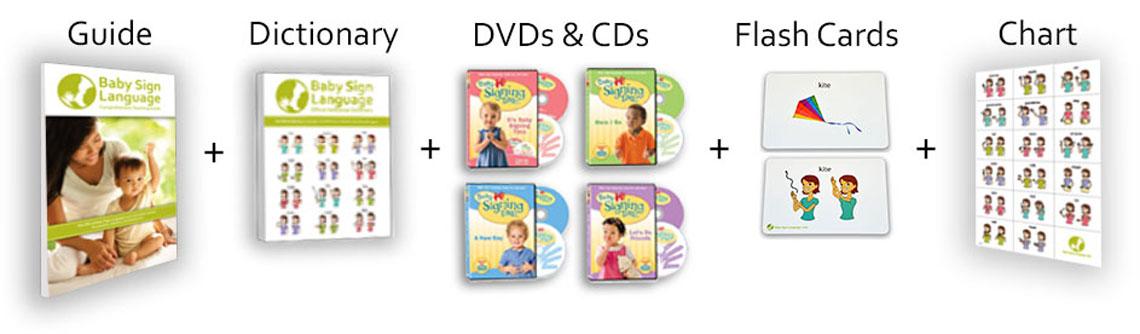
Our award-winning Baby Sign Language Kits get your baby signing faster.
- DVDs – Your baby learns to sign while being entertained by the music of Rachel Coleman & the Signing Time Crew.
- Flash Cards – Extend your baby’s vocabulary to people, foods, and animals with these sturdy flash cards.
- Teaching Guide – Utilize advanced topics for faster results, potty training, and transitioning to speech.
- Signing Dictionary – Have the right sign at your fingertips to satisfy your child’s curiosity.
- Wall Chart – Help grandparents, babysitters, and caregivers learn the basic signs.




Hi,
What about signs for cartoon characters? Do you have any or suggestion where to find it?
For example, how to sign “Humpty Dumpty”, “Cocomelon”, “Paw Patrol”, “Greench”, “Lilo and Stitch”, etc.
I understand that there may not be any cartoons that are completely in sign language, but I am simply seeking ways to sign specific characters so that my son can watch cartoons he likes and be able to communicate his preferences.
Hello,
What a thoughtful intention for your son! You are certainly free to join online forums for parents with hard-of-hearing children (remember, Google is your friend). Also, in my experience, parents/teachers can simply create their own sign of a TV show via acronyms (Example: “Paw Patrol” can be signed by its acronym “P P”, or a combination of the signs for “paw” and “patrol”. Another way is the longer way, that is, finger-spell the entire TV show’s name, “Lilo & Stitch”). Good luck!
To whom it may concern,
Could you be so kind to advise whom to contact via email for permission of copyright to use your online available material for personal use in printed handout format.
ADMIN – Hi Al Ghaliyah,
You are free to use our materials for as long is it is not for profit, and please reference our site if you share our materials with others. Please check our copyright here for reference. Since we also have had multiple authors build this site through the years, you may refer to this APA guide for referencing a site under no author. Cheers.
Do you have a sign picture for the word “mean” or “rude”? I am working with a student who has selective mutism and so we are teaching her signs at school. We are trying to find some way for her to tell us when someone did something mean to her and I haven’t found a word in the dictionary that fits. Thanks!
I’ve had a lot of luck here and been told that Bill Vicars is pretty accurate.
Hi Hannah, here is a video cluster that shows the ASL for “rude” and “mean” (in addition to “nice” and “respectful”, prior).
Do you teach Australian sign language as well or just American?
Just American Sign Language (ASL/BSL) here, Shanai. But there must be Australian SL online. You may even find some good ones on YouTube. Good luck!
The first thing I look up was cat.
But your flash cards show fingers open to close.
And your video shows the fingers staying closed.
I think your video is wrong
Hi Bob, thanks for stopping by. About the sign for CAT, the small matter of keeping the thumb and pointer finger closed – or opening and closing them – while the 3 remaining fingers remain splayed, is just that: a small variation to the basic sign. Please note that ASL (and other countries’ sign languages) all vary minutely or greatly. Even across the U.S. alone, ASL can have 2,3, or more variants. The important thing is that the sign being used in one’s own community is what is adopted, whether or not the initial signs that a parent or child learns are exactly the same as those of the community. Hope you enjoy learning!
I have a great nephew that may have autism. He has stopped talking. Do you think this program would be good for him?
I’m autistic. It’s nothing to be ashamed of or sorry for. It’s how our brains work. When I go nonverbal at times ASL has been an amazing resource for me to still communicate when I’m unable to speak. I’d highly recommend it! Best of luck learning how to communicate with your autistic nephew! Us auties are amazing 🙂
To whomever this administrator is that responded, please don’t express pity or disappointment when autistic people are mentioned. It implies that we are unnatural and something to be fixed. We aren’t. We just work differently.
Hello Indy, thanks for stopping by. On the matter of my original reply to Melanie, please note: I was expressing empathy for the fact that her great nephew stopped talking (something that has caused concern to many parents and guardians, simply because they don’t know what to make of it) – not that he has autism per se. Hope that’s clear. No offense meant to the autistic community – I am a sincere admirer of the gifts that autists also share with the community. Cheers!
Sorry to hear that, Melanie. It would not hurt to try BSL. However, if your family suspects autism, it may be prudent to reach out to specialists as soon as possible, too. Best of luck.
The videos are really good and informative. I like how you can watch the videos and learn them, and you can replay them as many times as you want to learn, and you can be able to teach BSL to the infants as well.
I’m learning and teaching ASL to a third grade class, is it okay If i teach them while using baby sign language?
Our website and products use ASL so it would be okay to use for your class!
I think these videos are really good and informative.
Hello!! If i want my baby to learn my mother language Spanish, which i will be speaking to all the time, is it okay to teach them at the same time ASL. We live in Canada.
Thanks!
The majority of Canada uses ASL or Quebec Sign Language so you it will be okay to teach the ASL!
I’m really interested in your books and products. Do you have a Chinese version?
Thanks
There is a Chinese Sign Language, which is unrelated to ASL or BSL. I would recommend looking for resources to learn that language, so that your baby signing efforts also aid in communication with local Deaf people.
Hi, Thanks for your interest! We don’t have a Chinese version. If you are learning BSL right now, you may consider your own “hack”, i.e., either download our flash cards and write the Chinese translation for each word, so that you can teach your baby bilingually speech-wise, but with only one hand sign, or buy any of our card sets so you can write the Chinese translations on those cards more easily. Cheers.
Do you have a spanish version of your dicitionary?
No, we don’t Sonya.
Do you have an app?
Hi Jamie, No app yet. In the meantime, feel free to browse our new dictionary pagesfrom your mobile phone. Flash cards can be directly downloaded on your phone as well. Cheers.
Is this based on ASL ? I am an teacher of English as a foreign language, and I am trying to teach using some ASL.
Hello, Carlos. Yes, Baby Sign Language is based on ASL. Cheers.
Hello,
My daughter is 18 months old. We started sign language because she wasn’t saying one word. Now in less then a month, she is using like 20 signs or more, and now she finally says three words. Should I expand her vocabulary in baby sign or would it make a delay on speech?
Do you have a kids’ app to learn sign language?
Hi Antonisha, We don’t have an app for this site, but do check out our entire Dictionary on mobile. Our mobile interface works just fine, and you can still access our video and download the flash card on each page.
Yes, I love the videos. Do you have any apps that would reach my kids?
Baby Sign Language has three types of benefits:
Practical: less fussing and more fun.
Emotional: creates a closer child-parent bond.
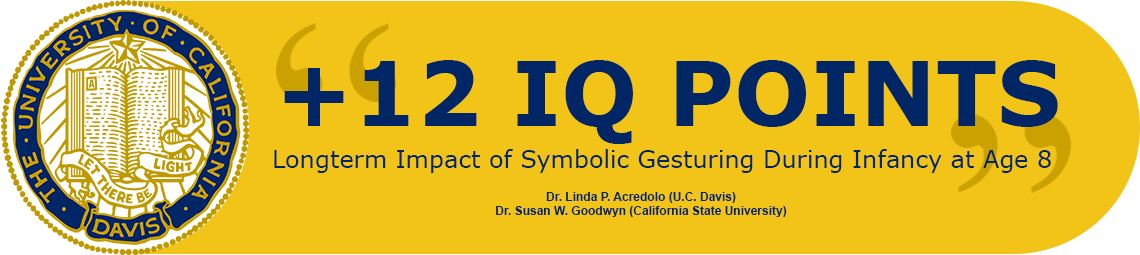
Cognitive: boosts brain development.
Hi Paula, That is great news — both that she has learned so many baby signs and that she has started to speak as well! Don’t worry about impeding her speech development if you continue signing. Baby Sign Language studies have actually indicated no speech impediments even in the continuance of signing, and in fact, BSL is known to help boost the child’s intelligence. So, keep signing and enunciating the words to your daughter. Speaking and signing at the same time can only help activate multiple senses in her. Have fun!
Is this sign language iconic? Is it the same as ASL Sign language?
Hi Jasmine,
Yes, Baby Sign Language is based on ASL. Please do note that ASL itself has some sign variants due to different source regions across America. Having said that, the signs are generally widely used by ASL signers spanning both coasts. Cheers.
es interesante saver
si, es interesante ver. ¿Puedo preguntar qué te pareció más interesante?
Can babies & children speak sign language with each other without any adult around?
Hi Ken, Absolutely, though this wouldn’t preclude them from trying to utter their first words (or babble) with each other either. 🙂
Howdy,
I was given some of your DVDs and don’t have a player. After watching a few of your introductory videos, I’d like to know if you have downloadable content for sale in lieu of DVDs?
Thank you!
Alissa
Hi Alissa, Thanks for asking. Have you tried playing the DVDs on your PC’s/laptop’s CD/CD-ROM player? That should work fine. Cheers.
Laptops don’t have cd/dvd players anymore. At least not the good ones 😂 Young people having kids now, don’t have DVD players. Haha! I’m 34 and It’s been over a decade since I’ve owned or used a DVD/CD. I’d love a digital download as well.
I also would like a digital version. I don’t want to buy a DVD (it would be the only one in my house). I would pay the same price if you updated your medium to digital.
I’m afraid we don’t have a digital compilation for sale at the moment. However, I hope you’ll bookmark our sign pages as our videos are readily accessible on each page. We’re also developing a few hundred more sign pages now. We will keep you posted when we eventually get around to a digital version of our products. Cheers!
The DVD can be replaced with a flash drive too. Is that option being considered?
Thanks for your comment, Nkem. We are likely to go all digital soon though, so bookmark our page for any future changes.
THIS LESSON CONFIRMED WHAT I HAD LEARNED WITH MY DEAF SON, AND WE ARE LEARNING MORE AND MORE SIGNS DAILY. THANK YOU!
Wish this was more affordable.
We have used the ‘milk’ sign, ‘eat’, ‘more’, and ‘all done’. It’s so amazing! I will be ordering a kit as well.
I’ll be ordering a copy of the book for signing to help my son learn easier!!!
If a grandparent is called nana or papa would you will use the grandmother and grandfather sign?
ADMIN – Hi Leanne,
Yes, the sign is for the relationship and not for the naming attribute.
Great stuff! The Basics/Quickstart info helps us know where to begin learning and teaching sign language to our kids. Keep up the awesome work!
Is there a separate sign for nursing? Or should I just use milk for both a bottle and nursing?
ADMIN – Hi Brianna,
I use the same sign for simplicity
At what age do you recommend starting to teach signs to a baby?
ADMIN – Hi Brittany,
We have seen the highest levels of impact when parents begin using between six to eight months.
Is this American Sign Language, or are any of them made up “baby signs”?
ADMIN – Hi victoria,
It is adapted ASL. This means some signs have been simplified to match the motor skills of a baby.
This was very helpful! I am definitely getting your Baby Sign Language book!
Great to hear that, Jennifer. Let us know how it goes once you’ve ordered the book for signing. Have fun learning with your son!
The more I learn about ASL, the more fascinated and intimidated I get. ♥
My husband keeps thinking that the 10 week old babies that are signing are just super smart babies. I think it’s due to the amount of exposure and/or better fine motor skills the baby may have. Can you set us straight? lol
ADMIN – Hi Shawndra,
It is not a matter of IQ. It is generally a matter of engagement and environment.