


Step One:
Making Signing Fun
Have fun with your baby. Baby Sign Language is a way for you and your baby to bond. Babies love learning the new signs and the feeling of being understood. When you make it fun, your baby will learn faster, and you will establish a framework for making learning something your baby wants to do. Here’s how:
1. Introduction
Signing is naturally fun. You will notice that babies, even as young as a few months old, often smile or giggle when you sign at them, before they even begin to understand signing. Getting your undivided attention and knowing that you are trying to play with him is just inherently enjoyable to a baby. Babies have a natural curiosity and will find joy in learning how to communicate.
Fun is important, because fun helps baby learn faster. When signing is a favorite part of her day, baby will be more motivated to try signing and stick with it even if it feels difficult at first. Fun is also important because it sets the foundation for future learning interactions. This is your first time teaching baby and you want to establish the pattern that learning from you is something she wants to do.
To keep signing fun, we set a playful tone, we use signs that baby is motivated to learn, and we sign at the right time and place.
2. Set a Playful Tone
Babies take their lead from their parents and caregivers. If you are having fun, they are going to have fun too.
Incorporate signing into the enjoyable activities you already do with baby. Sign along to your favorite songs and sign as you go for a walk and spot a dog or eat your grapes. For older babies, we play games like naming the colors with the baby sign language flash cards. Just enjoy being able to send each other an I Love You baby sign, just because.
Animate your signs to add a bit of drama. Babies love drama (and don’t appreciate subtlety). Really put a lot of emotion into them. When you do the sign for excited, raise your pitch and widen your eyes. When you sign sad, have a long face. When you are signing lion, let out a roar.
Celebrate your signing successes. We will discuss this in greater depth in the section on encouragement.
3. Motivate Signing
We make signing more appealing when we choose signs that interest babies and harness their natural curiosity.
The most common first signs are mom, dad, eat, milk, more, and dog, because these are all things that interest babies. A baby wants to learn these signs because they help him to communicate about things that are important in his life.
A common mistake is to attempt to push our agenda and teach things like courtesy signs (please and thank you) as first signs. The problem with these signs is that to a six month old, they don’t mean anything and there is little motivation to learn them.
Instead, focus on signs that are tangible and related to something that baby already finds fascinating. If what gets her attention is the fan, light, flower, or cat, then these make ideal candidates for signing. Some babies want to learn animal signs, some are more motivated by colors, and others by foods. Let their interests be your guide.
4. Right Time & Place
You want to set up an environment that is conducive to your baby learning. Babies have a short attention span and their attention usually shifts to the loudest, most energetic thing in the vicinity. So turn off distractions like TV or flashing toys.
Baby’s position should allow her to see you and for your signs to be in the center of her field of vision. Babies do not have very good peripheral vision and if you are signing off to the side, they are going to miss the signing.
Baby’s moods can be fickle and not much learning happens when baby is hungry, tired, or otherwise cranky. So time your more formal signing session to coincide with times when baby is well rested and well fed. After a nap or after meals is usually a good time.
Next: Step Two – Repetition, Repetition, Repetition
Previous: Baby Sign Language Basics
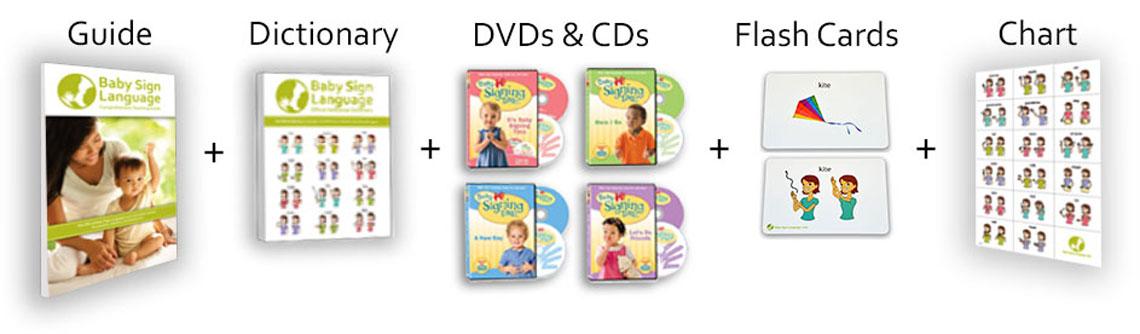
Start Signing with the Baby Sign Language Kit
Our award-winning Baby Sign Language Kits gets your baby signing faster.
- DVDs – baby learns to sign while being entertained by the music of Rachel Coleman & the Signing Time Crew
- Flash Cards – extend baby’s vocabulary to topics like household items and animals with these sturdy flash cards
- Teaching Guide – covers advanced topics for faster results, potty training, and transitioning to speech
- Signing Dictionary – always have the right sign at your fingertips to satisfy your baby’s curiosity
- Wall Chart – help grandparents, babysitters, and caregivers understand the basic signs





I really want to learn sign; do you have any harder sign language?
Great to hear that, Ruby! Take time and enjoy familiarizing yourself with our (more than 1,000) sign pages, complete with videos and flash cards! Beyond that, there are plenty of ASL resources for adults online. Cheers!
Is it too late to sign with my toddler? He just turned 17 months old. He tried to sign ” eat ” and ” hat” signs to me back, but I think he doesn’t understand what they mean… Please let me know if it’s too late to sign.
Hi Kuralay, Not at all! Please go ahead and sign with your toddler. If adults can learn ASL, then there is no age limit, really. Please remember to follow our tips on our BSL site. Have fun learning and signing with your toddler!
need the easiest baby sign language ever
I started signing with my baby right from the beginning. I teach Baby signs classes so I am familiar the teaching process. My baby didn’t start until he was 9 months and then he used it very rarely until 12 months. He’s not 19 months and has at least 50 signs. We persevered and we’re so glad. Not only does it help us understand him but it’s so CUTE when he does his signs.
Does it really take months for a baby to start signing back? I think I was doing something wrong, I had started trying to teach my son at 6 ½ months and gave up pretty quick because he didn’t even seem to notice I was signing. Was it just bad timing? I guess it doesn’t help that no one else would sign with him, right? I wish I could afford a kit I’d be buying it right now. My son got into a whining at everything phase and it is so frustrating not knowing what he wants.
ADMIN – Hi Lee, Most parents that start at six months see results between month 8 and month 12. There needs to be consistency and continuity to achieve results. Join us on Facebook and ask other moms what worked best for them.
We started our son on sign language when he was 6 months old. Sign language has made our whole familys life much easier and peaceful. My friends thought i was crazy when we told them we’d been doing sign language. But they now know that sign language is much easier than it looks. Sign language has helped us alot!