

Step Three:
Encouraging All Efforts
Once your baby starts signing, you want to reward her efforts with lots of encouragement. Learning to sign is challenging for babies and a little encouragement helps keep them engaged.
- Approximations – recognizing early signs
- Stages of Signing – development of signing
- Forms of Encouragement – ways to encourage signing
1. Introduction
Signing is naturally fun. Did you ever notice that babies who are just a few months’ old will often smile or giggle when you sign at them, even before they understand signing? Getting your undivided attention and knowing that you are trying to play with them is inherently enjoyable to babies; they have a natural curiosity and will find joy in learning how to communicate.
Fun is important because fun helps baby learn faster. When signing is a favorite part of her day, baby will be more motivated to try signing and stick with it even if it feels difficult at first. Fun is also important because it sets the foundation for future learning interactions. This is your first time teaching baby and you want to establish the pattern that learning from you is something he wants to do.
To keep signing fun, we set a playful tone, we use signs that baby is motivated to learn, and we sign at the right time and place.
2. Approximations
At first, the signs your baby makes will only be an approximation of the proper baby signs. Babies don’t have the motor skills to do the signs perfectly, so they will make approximations. These approximations are usually a less-detailed version of the full sign and may barely be recognizable. Parents often miss these first attempts at signing if they aren’t on the lookout.
Approximations tend to involve the gross motor muscles but will be missing a lot of the fine detail. For example, the sign for daddy is properly performed be tapping the thumb on the forehead. Your baby’s first approximations will usually look more like they are just flailing their arms up and down. The baby may also use both hands instead of just one hand.
Timing of the initial signs is often delayed. The baby will often sign back as much as 60 seconds after you initiated signing. It takes a lot of effort for babies to control their arms and hands, so you will often see a look of intense concentration as the baby thinks about signing, followed by a burst of hand movements.
In the video above, note how Kennedy signs more (at the 0:30 mark) and uses only one hand instead of both. The movement is much too big and uses the gross motor muscles in the arm and not the fine muscles in the fingers. Kennedy’s signing is a few seconds delayed, but it is still quite clearly an attempt to do the sign for more, which her mom is rewarding by acknowledging the attempt and giving her what she wants.
These approximations and delays are perfectly normal. They are the way that all babies start to sign. With practice, signing will become more precise and more prompt as their fine motor skills develop. You encourage your baby to improve their signing by recognizing and rewarding their approximations.
(Courtesy: Eat Clean Play)
3. Stages of Signing
You will usually see three stages of progression when starting with baby sign language:
Stage One: Imitation
The first step toward signing is that your baby will start copying your signs. A normal part of a baby’s development is to copy the gestures of the people around her. So when you are regularly performing the signs, your baby will naturally copy you and make the signs right back. While she does not understand what her signs mean at this stage, she is learning how to perform the signs making this a useful first step.
Your baby will think this is grand fun.
Stage Two: Association
In the second stage, your baby will start to associate the sign with some concept. She may start making the right sign when something triggers the association. For example, she will sign dog whenever the dog is nearby. At this stage, your baby has made the connection between the word and the concept.
Stage Three: Communication
The last stage is when your baby starts using the signs to communicate something to you. For example, if she is hungry, she may sign milk. In this last step, your baby has learned that she can use the signs to communicate her needs and feelings to you. This is the stage where signing really starts to get useful.
4. Motivating Signing
When you see baby signing, particularly those initial attempts to sign, you want to encourage their effort. There are many ways you can reward the signing as follows:
Acknowledgment
The most powerful thing you can do to reward your baby for signing is to acknowledge their attempt to communicate. Knowing that you understood what they are saying is a tremendously rewarding experience for a young child. So if your baby attempts the sign for cat, give her your full attention and repeat back to her the word cat as well as the sign cat.
Emotion
Respond to baby with enthusiasm, showing that you are excited about her signing. Show emotions and make exaggerated sounds and gestures to show that you are happy. You want to project a calm positive energy to show baby that she is doing something important. In much the same way you work hard to get a giggle out of your baby, your baby will want to work hard to keep getting this emotional reaction from you.
Gratification
Where possible, if baby makes a request via sign language, you want to gratify the request. So if baby signs water, get baby some water. This will not always be practical, but where it is possible, give baby what she wants.
When you can’t get baby what she wants, still provide acknowledgement and emotion as positive reinforcement. It is rarely a good idea to ever ignore an attempt to sign. This creates more frustration for baby, because not only is she not getting what she wants, she is also not feeling understood.
Next: Step Four – Expand Vocabulary
Previous: Step Three – Encourage
Start Signing With The Baby Sign Language Kit
Our award-winning Baby Sign Language Kits gets your baby signing faster.
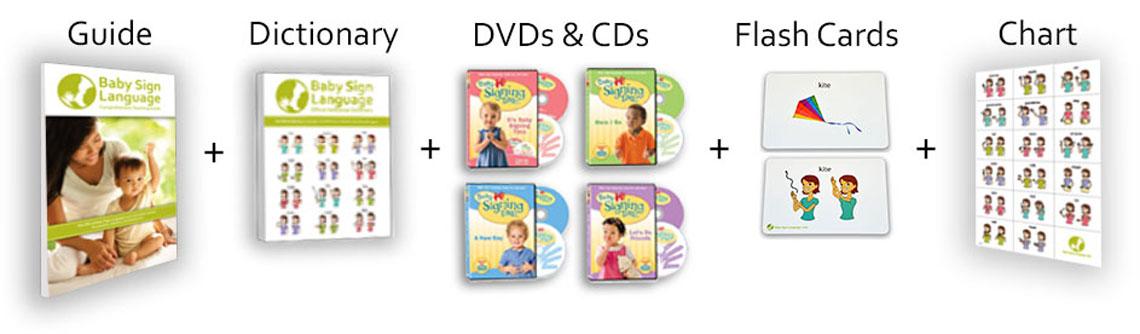
- DVDs – baby learns to sign while being entertained by the music of Rachel Coleman & the Signing Time Crew
- Flash Cards – extend baby’s vocabulary to topics like household items and animals with these sturdy flash cards
- Teaching Guide – covers advanced topics for faster results, potty training, and transitioning to speech
- Signing Dictionary – always have the right sign at your fingertips to satisfy your child’s curiosity
- Wall Chart – help grandparents, babysitters, and caregivers understand the basic signs




We’ve been signing pretty much since the birth of our little girl who now is 16 months old, but although she is very good at recognizing the signs and clearly understands them – she will pick up the cards when we do the signs or get her toys depending on what it is we are signing – she will only do a couple of signs back and often use the same sign for several things. Any suggestions on how to get her to use the signs more?
ADMIN – Hi George,
We had a similar situation with my niece. Given your daughter’s age you are about to have a verbal child so I would not worry that much. With my niece we created games of recognition using the flash cards and rewarded her with mini candy. We used the same approach for potty training.
I love your product and wish I had known this earlier to use on my now 8, 6 and 4 yr. olds. It just makes Parenting so much fun and easier. Now, seeing this for the very first time, I wonder how early should a parent or professional start signing with a baby?
ADMIN – Hi Nkechi,
Six months is a good age to start. You can start earlier, but it takes longer to see results and sometimes people get discouraged. At six months, you usually see results within a couple of month.
I am mightily impressed. This is good stuff. It is logical. Kids OUGHT to communicate with mom, dad, grandpa, grandma, with baby sign language prior to being able to do much with their voice. I think this is SO important that I plan to start pestering Florida school districts that the districts need to find a way to encourage baby sign language at the earliest possible age…with the district’s main goal being the improvement of the child’s spoken vocabulary. This is SO logical that I kick myself for not having suggested baby sign language with my first 2 granddaughters. I started looking at your websites and other related sites only after granddaughter #2 used the “more” sign when, at age 1.5 she wanted more food, at times when I was the babysitter! NOW grandpa will be using every opportunity to teach baby sigbn language to granddaughter #3 who is about 10 weeks old. Grandma and I will spend New Year’s Eve with her, doing some baby sign language as part of the celebration…while all the other adults are gone. (Now…on what I think is a related subject…I do think there are other examples where we teach things in the wrong order. Just as we should recognize that a child normally can probably sign before speaking…I think we should also teach typing, aka keyboarding, prior to making the poor kid hold a pencil and attempt to draw difficult shapes. Signing should come before speech. Similarly typing should come before printing.) From doting grandpa, Andy Johnson, Jacksonville\r\noops. P.S. When I was a member of the legislature, I was often involved in issues relating to the hearing impaired. (I was the sponsor of legislation which created the Florida Council of the Hearing Impaired back in 1979.) I think we waste lots of energy in Florida schools with sign language as the completion of the language requirement. BUT if one purpose in learning ASL in school could be for people who want to work with infants, baby sign language, then ASL in school would take on a better justification than merely serving as the easiest way to kill the language requirement.
Ladies, thank you so much for this incredible service you are providing. It makes so much more sense to see the signs via video! I can’t wait to try these out with my son. Many, many thanks.
I am originally from Quebec and currently live in Miami with my husband and 7 months old son Ryan. We are about to get Ryan started on baby sign language. We plan to move back to Quebec in a few months. I know that there is ASL and CSL. I would like to know if there are different versions of baby sign language too?
ADMIN – Hi Valentina,
Baby sign language does not have any official language, and different teachers will use different sign languages, and some will even create their own sign language.
Baby Sign Language as taught on this site follows American Sign Language (ASL). Nearly all the signs we use are purely from ASL. We do this primarily because most of our audience is American – so if you do want to go on with signing in the United States then ASL is the best way to get started. And secondly, ASL is the most widely used English based sign language so there are lots of resources available to help you teach your child (videos, flash cards, etc). Finally, ASL is the most commonly used for baby sign language so is what most babysitters, nannies and pres-schools use.
Other English speaking nations use other sign languages, the British uses British Sign Language (BSL). In Quebec, a french based sign language (LSQ) is the dominant sign language. (English speaking parts of Canada tend to use ASL)
My advice to parents in choosing their sign language is that if you live or plan to live in another country and you want your child to continue with their signing beyond childhood, you might consider teaching the local sign language. If you don’t intend to go on with signing, ASL is a good choice because of the abundance of resources. And whatever you choose, don’t stress the decision, your child can easily switch later on.
I have a daughter who was recently diagnosed with very complex cognitive disorders & autism. Is Makaton the same as baby sign language. Are these resources interchangeable? I really appreciate your help and love your website.
ADMIN – Hi Mercy,
Makaton is a sign language that is designed with people with disabilities. The signs are different from American Sign Language (which we use). If you think your daughter will grow up to use Makaton, I would use that instead. You would use the same teaching methods, just different signs. If not, stick with American Sign Language, it is much more widely used and there are many more resources available.
I am a mom trying to teach sign language to a nine month old and a toddler with communication delays. I have searched several baby sign language websites trying to find out if it is more appropriate to reward babies with praise or material things such as food or toys. Your guidance is greatly appreciated.
ADMIN – Hi Luciana,
Rewards are great. The best rewards are related to the sign. So if baby signs water, get them some water. Or if you are doing say animals, have some figurines that you give them when they do the appropriate sign.
Another great reward is giving them attention when they sign and showing you understand. They have such a desire to communicate, and knowing that you understand is a big reward.
Praise, and the occasional treat is fine too.
If you are setting time aside to teach your baby sign language to allow them to communicate earlier in their developmental stages, How long should a learning session of baby sign language last? Do babies get restless or frustrated when learning sign language for babies?
ADMIN – Hi Marianne,
For the young ones, we usually teach them primarily by integrating signing into our day. For example, meal time is a great place to practice more, all done, water, milk, etc. They learn faster that way, and the whole thing is more fun.
Once they are older, and have a few signs under their belt we do some play based learning, such as naming flash cards or figurines.
The perfect length of session is just shorter than their attention span. We try and keep them wanting more by ending sessions while they are still enthusiastic rather than having to drag them through. It will vary a lot day-to-day and child-to-child. But, for a one-year old 5-10 minutes will often be the maximum. At 2 years old, some of them will be engaged for up to half-an-hour.
I am wondering if anybody here has experience in using baby sign language to help orphans recently adopted experiencing affective disorders. We adopted a child from Haiti and have encountered challenges communicating verbally. She is 3 now and often uses pointing pulling and tugging to get our attention. She is distracted with ease and prone to crying. We want to try baby sign language hoping that it will open a window to facilitate communication with her and reduce her stress and frustration due to inability to verbalize. We have heard of some parents that have tried it with success. Any help you can give me is truly welcome. We want our baby to achieve and catch up with the rest of the kids.
ADMIN – Hi Ruth,
Baby sign language is often used by speech pathologists as a path to vocalization for children having difficulties talking. Children often find it easier to make gestures, and once they have made that step, and are getting comfortable talking then talking is the natural next step.
With a girl that age, and with her history, we would suggest you see speech therapist. These problems are usually much easier to fix when they are addressed early than if you wait too long and the language window starts to close.