


Hurt
To sign hurt, take your two hands and make each into a fist with your index finger extended. Point the index fingers of each hand at one another and twist the two hands back and forth in opposite pivots. Now if only there was a sign for hurt that adults could use with one another.
The sign is placed at the location of the hurt.

SIGN USAGE
When a child visibly hurts themselves, make the sign over the location of the hurt. You can also do hurt with picture books where a character has perhaps a bandaged paw. Hurt is a tremendously useful sign. Funny enough, when a child is hurt, just being able to communicate to you that they are hurt and to have you understand that is worth as much as any medicine.
RELATED SIGNS






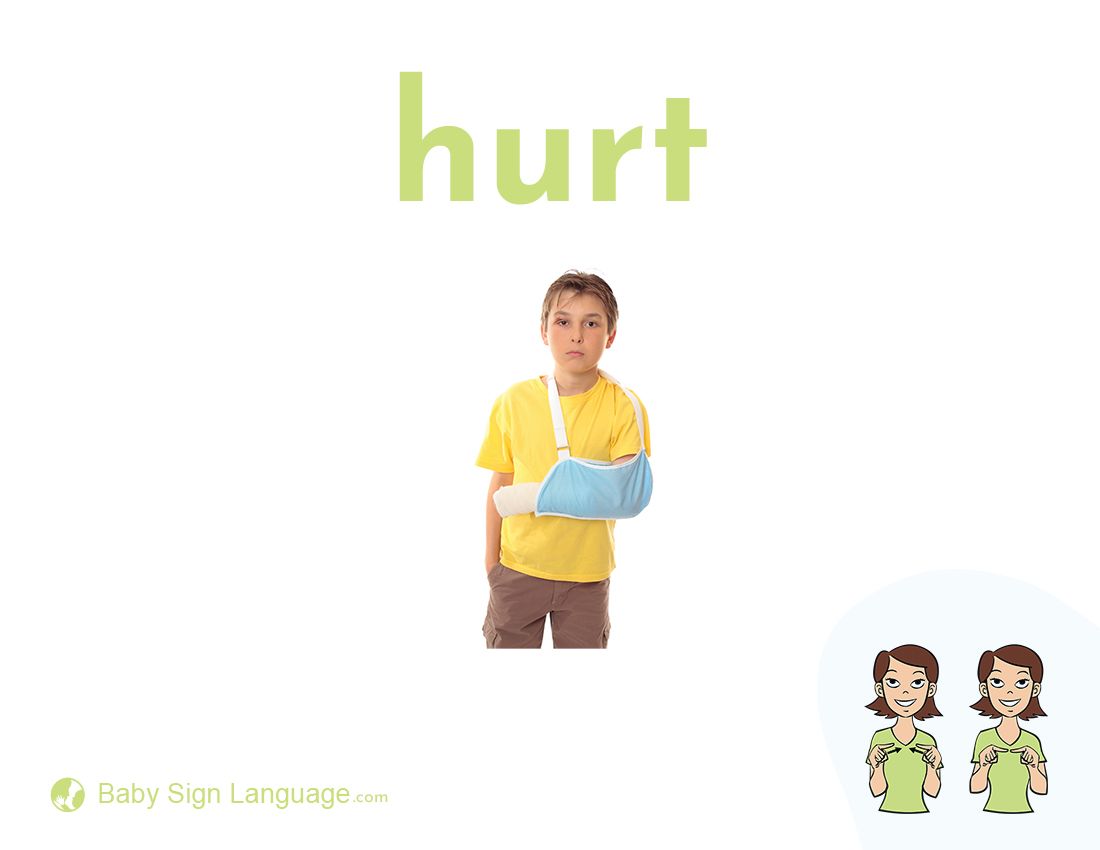
Flash Card
Hurt is a really useful sign to teach because it can really make both of your lives a lot easier. If your baby can communicate to you when she gets hurt, it allows her to share her hurt with you. You may not be able to do anything lots of the time, but it is often surprising how better it feels for your baby if you just give their hurt knee a kiss, a little rub, and a little empathy.

2 Responses to “Hurt”
Leave a Reply
SHOP
Baby Sign Language Premium Kit (Online Video)
Get all four volumes of Baby Signing Time...
Original price was: $170.92.$87.95Current price is: $87.95.
Learn More



Hi! I have found several different signs for “scar.” Would you recommend dragging the pointer finger down to indicate a scar? Thank you!
ADMIN – Hi Maura,
Yes, that would be my choice.
Hi, I’ve just been looking at your site as I’d like to teach signs to my baby to begin to help him communicate. The videos and images in the dictionary are immensely useful so thank you! I was looking at the sign for “hurt” though and am a little confused as the video and the image show different signs. Both start with the index fingers pointing to each other, but do you then tap (like the video) or twist (like the image) or does it not really matter?
Also, are there any guidelines on an ideal age to start signing? I’m well aware my baby is probably a bit young still (at 4 months!) but thought it couldn’t hurt showing him a couple of basic signs now.
Many thanks!
ADMIN – Hi Nichola,
Tapping the index finger together (shown in the video), and making a twisting motion (shown in the diagram) are both variations for hurt in American Sign Language. I find the tapping variation is the easier for a baby to perform, but feel free to do either.
Six months is a good age to start. Starting earlier never hurts, you just have to be a bit more patient to see results. Keep us posted.